
· Manaloahealth
For most of the last century, scientists thought of body fat the way you might think of a storage closet. It was where the body stuffed extra calories, an inert cushion that sat quietly until you needed to burn it. That picture turned out to be wrong.
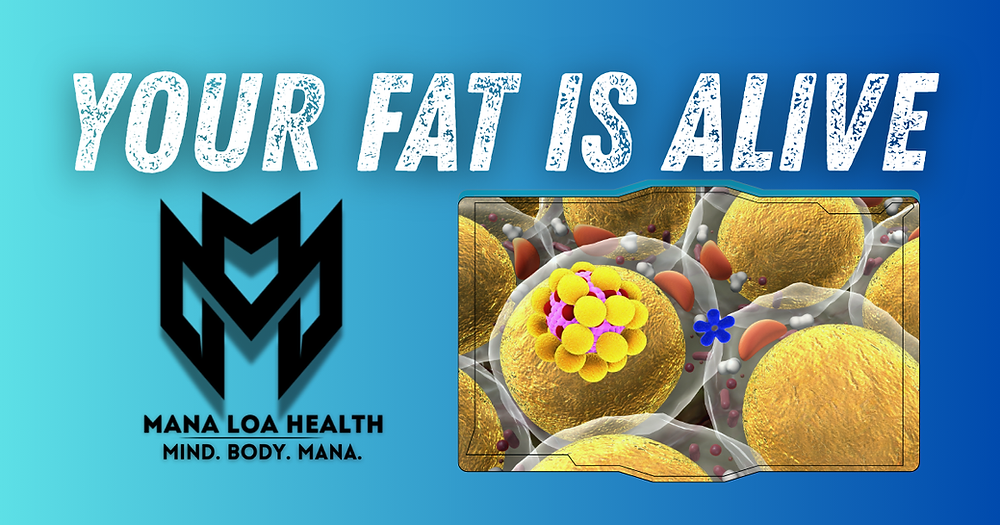
Modern research has completely rewritten the story. Adipose tissue, the scientific name for body fat, is now understood to be a living, dynamic endocrine organ that actively talks to the rest of your body, releases hormones, and helps run your metabolism from moment to moment. Here is what the current science actually shows.
From storage closet to control center
The shift in thinking is well documented across the recent literature. Reviews now routinely describe how our understanding of adipose tissue has moved from viewing it as simple energy storage to recognizing it as an active endocrine organ that influences processes throughout the body (Choubey and Nikolettos, 2024). Fat was once considered metabolically inert, but research over the past few decades has revealed that it regulates food intake, energy balance, insulin sensitivity, body temperature, and even immune responses (Ahmed et al., 2024).
In other words, your fat is not a passive passenger. It is participating in the conversation.
The hormones your fat makes
The reason fat qualifies as an endocrine organ is that it manufactures and releases its own hormones. These are collectively called adipokines, and they travel through the bloodstream to act on distant organs like the brain, liver, and muscle (Xie and Li, 2023).
Two of the best studied are worth knowing by name:
Leptin is often called the satiety hormone. Fat cells release it in proportion to how much fat you carry, and it signals the brain about your energy stores, helping to regulate appetite and food intake (Ahmed et al., 2024).
Adiponectin is one of the most abundant adipokines in the bloodstream, and it works in the opposite direction of many fat-related problems. Its levels tend to be inversely associated with insulin resistance, meaning higher adiponectin generally tracks with better metabolic health. It plays a meaningful role in how the body handles both glucose and fat (Ahmed et al., 2024).
Beyond these two, fat tissue produces a long list of signaling molecules, including resistin, visfatin, omentin, and inflammatory messengers like TNF-alpha and interleukin-6 (Jung and Choi, 2015). Some of these are anti-inflammatory and protective; others are pro-inflammatory. The balance between them is a big part of what determines whether your fat is helping or hurting you.
Not all fat is the same
Another key discovery is that "fat" is not one substance. There are functionally distinct types, and they behave very differently.
White adipose tissue is the classic energy-storage fat. Its cells hold a single large droplet of fat and relatively few mitochondria, the tiny power plants inside cells (Comparative review, Frontiers, 2026). This is the fat most people are thinking of.
Brown adipose tissue is the metabolic overachiever. Its cells are packed with mitochondria and express a protein called UCP1, which lets them burn energy specifically to generate heat, a process called non-shivering thermogenesis (Pallio and Mannino, 2024). Rather than storing calories, brown fat spends them.
Beige fat sits in between. These are cells within white fat depots that can be recruited to behave more like brown fat under the right conditions, such as cold exposure, a process known as browning (Ahmed et al., 2025).
For a long time, scientists assumed brown fat essentially disappeared after infancy. We now know adults retain functional brown fat, and its activity appears to matter. In a study of over 4,000 adults, detectable brown fat activity was inversely related to central obesity and to a worse metabolic profile, meaning people with more active brown fat tended to be metabolically healthier (Wang et al., PLoS ONE).
Where your fat sits matters too
Location turns out to be as important as quantity. Research consistently distinguishes between two white fat depots with very different reputations.
Visceral fat, which packs in around the abdominal organs, is the troublemaker. It is described in recent reviews as a critical site of inflammation and metabolic dysfunction, and it is closely tied to conditions like insulin resistance, type 2 diabetes, and cardiovascular disease (Ahmed et al., 2025).
Subcutaneous fat, which sits just under the skin, appears to be more benign and may even retain protective features, especially in early obesity (Ahmed et al., 2025). This helps explain why waist circumference can tell you more about metabolic risk than body weight alone.
When the system breaks down
Because fat is an active signaling organ, it can malfunction. In obesity, fat cells become enlarged and stressed, and the tissue attracts immune cells that drive a state of chronic, low-grade inflammation (Jung and Choi, 2015). This shifts adipokine production toward the pro-inflammatory side and disrupts the healthy signaling described above. The result ripples outward, contributing to insulin resistance and a cascade of problems affecting the liver, heart, blood vessels, and beyond (Deng et al., 2024).
In this sense, many of the health consequences we associate with excess fat are not just about the weight itself. They are about a signaling organ that has stopped sending the right messages.
The encouraging part: fat is changeable
The flip side of all this is that adipose tissue is remarkably plastic. It responds to how you live. Cold exposure can activate and recruit thermogenic fat, and even in adults where brown fat is hard to detect at rest, prolonged cold acclimation can still produce measurable metabolic activation, suggesting many people retain an inducible thermogenic reserve (Thermogenic adipose review, 2025). Exercise, nutrition, and dietary patterns all influence adipokine levels and adipose function (Ahmed et al., 2024).
Your fat, in other words, is listening to what you do. That is a far more hopeful picture than the old idea of an inert lump you are simply stuck with.
The bottom line
Body fat is not dead weight. It is a sophisticated, hormone-secreting organ that helps regulate appetite, blood sugar, inflammation, body temperature, and metabolic health across your entire body. Its behavior depends on which type it is, where it sits, and how you treat it. Understanding fat this way reframes the whole conversation about metabolic health, away from a simple story about numbers on a scale and toward a richer picture of an organ you can actually influence.
Currently treating patients located in:
Colorado, Florida, Hawaii, and Washington!
Click the link to schedule a consultation today!
https://mana-loa.clientsecure.me
-The Mana Loa Health Team
Patient safety is Mana Loa Health's top priority. The information discussed on this blog is not intended to recommend the self management of health problems or wellness. It is not intended to endorse or recommend any particular type of medical treatment or advice. The information provided on this website is for informational purposes and not a substitute for professional medical advice, diagnosis, or treatment. If you have questions or concerns about your health, please talk to your healthcare provider. No information contained on this blog should be used by any reader to disregard medical and/or health related advice or provide a basis to delay consultation with a physician or a qualified healthcare provider.
References
Choubey M, Nikolettos N. Editorial: Adipose tissue and adipokines: their roles in human reproduction. Frontiers in Endocrinology, 2024. https://www.frontiersin.org/journals/endocrinology/articles/10.3389/fendo.2024.1497744/full
Xie L, Li X. Editorial: Roles and mechanisms of adipokines in metabolic diseases. Frontiers in Endocrinology, 2023. https://www.ncbi.nlm.nih.gov/pmc/articles/PMC10657989/
The Role of Adipose Tissue and Nutrition in the Regulation of Adiponectin (review). PMC, 2024. https://www.ncbi.nlm.nih.gov/pmc/articles/PMC11313710/
Jung UJ, Choi MS. Adipokines Mediate Inflammation and Insulin Resistance. PMC. https://www.ncbi.nlm.nih.gov/pmc/articles/PMC3679475/
Pallio G, Mannino F. New Insights into Adipose Tissue Metabolic Function and Dysfunction, 2nd Edition. Int. J. Mol. Sci., 2024. https://www.ncbi.nlm.nih.gov/pmc/articles/PMC11394891/
Comparative anatomy and metabolic profiles of brown and white adipose tissue in humans. Frontiers in Endocrinology, 2026. https://www.frontiersin.org/journals/endocrinology/articles/10.3389/fendo.2026.1821542/full
Key Roles of Brown, Subcutaneous, and Visceral Adipose Tissues in Obesity and Insulin Resistance (review). PMC, 2025. https://www.ncbi.nlm.nih.gov/pmc/articles/PMC12110630/
Brown Adipose Tissue Activation Is Inversely Related to Central Obesity and Metabolic Parameters in Adult Human. PLoS ONE. https://www.ncbi.nlm.nih.gov/pmc/articles/PMC4403996/
Thermogenic adipose tissue in older adults with obesity: a narrative review of mechanisms, brown fat resistance, and the translational relevance of exercise and nutrition. PMC, 2025. https://pmc.ncbi.nlm.nih.gov/articles/PMC13216019/