
· Manaloahealth
Somewhere inside you, right now, there are trillions of microscopic machines humming away like a city that never sleeps. You've never thanked them. You've never even met them. But every heartbeat, every thought, every time you haul yourself off the couch, that's them, clocking in.
They're called mitochondria, and they might be the hardest-working thing you own.
So what actually is a mitochondrion?
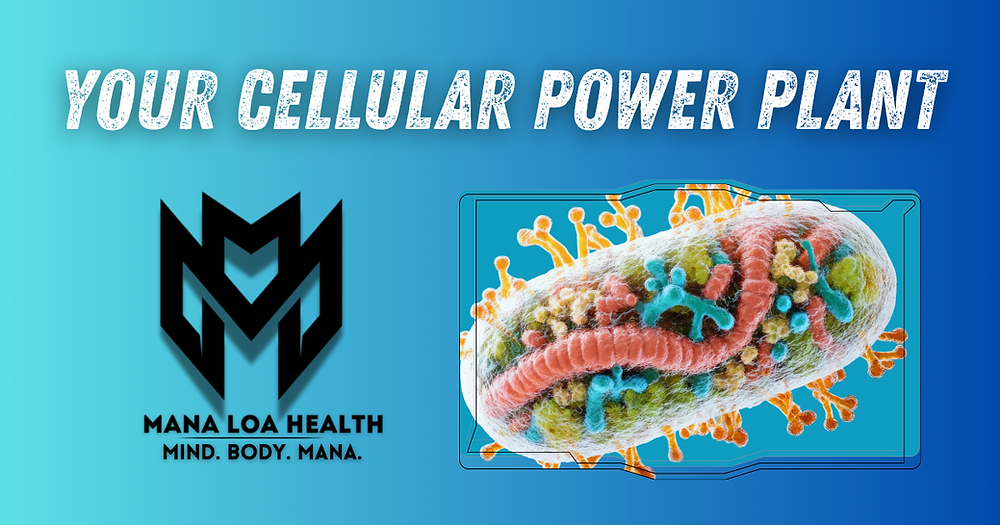
Picture your cell as a tiny factory town. It's got walls, a management office (the nucleus, holding the blueprints), and workers. But a town needs power. That's where mitochondria come in. They're the power plants, tucked inside nearly every cell in your body, cranking out the energy that keeps the lights on.
That energy comes in the form of a molecule called ATP, which you can think of as rechargeable batteries. Your mitochondria take the food you eat and the oxygen you breathe and use them to charge up an astonishing number of these little batteries every single day. No ATP, no anything. Your muscles wouldn't twitch, your brain wouldn't fire, and your cells would basically stage a walkout.
Here's the fun part: mitochondria are so important that scientists now see them as far more than just batteries. They're central hubs of cellular metabolism and signaling, playing key roles in stress response, inflammation, calcium balance, quality control, and even deciding when a cell should live or die. They're less "power plant in the basement" and more "power plant that also runs the town's emergency services, sends the mail, and votes on the budget."
The plot twist: they used to be their own thing
Here's a wild fact that never stops being cool. Mitochondria have their own DNA, separate from the DNA in your cell's main office.
Why? The leading theory is that, billions of years ago, mitochondria were free-living bacteria. Then one got swallowed by a larger cell, and instead of becoming lunch, the two struck a deal. You give me energy, I'll give you a home. That partnership worked out so well that it became the foundation of basically all complex life, including you.
So yes, you are, in a sense, a walking alliance. A merger that's been going strong for two billion years.
Why should you care? Because they're tied to almost everything
When your mitochondria are happy and plentiful, you feel it: steady energy, better stamina, a metabolism that hums. When they start slacking off, things get wobbly.
Researchers have increasingly linked mitochondrial trouble to a long list of conditions. Dysregulation of mitochondrial function is now considered a hallmark of many diseases, including type 2 diabetes, cardiovascular disease, metabolic syndrome, cancer, and Alzheimer's disease. That's a heavy hitter of a list, and it's a big reason mitochondria have gone from a footnote in your high school biology textbook to one of the hottest topics in health science.
And then there's aging. This is where it gets personal for all of us. Mitochondrial dysfunction and oxidative stress are widely regarded as primary drivers of aging itself, and are tied to a range of age-related diseases. As the years add up, mitochondria tend to get fewer, sloppier, and less efficient. The aging process disrupts how they divide and repair themselves, reducing their number, function, and overall health. In other words, part of what "feeling old" actually feels like is your power plants running at reduced capacity.
Quick myth-buster while we're here: you may have heard that mitochondria are villains because they produce "free radicals," the reactive molecules that can damage cells. The truth is more nuanced and more interesting. For a long time, those reactive molecules were thought to be purely harmful, but we now know they also act as important signaling molecules. Like most things in biology, it's about balance, not good guys and bad guys.
The best news you'll read today: you can actually help them
Here's where you get to stop being a spectator. Your mitochondria aren't a fixed hand you were dealt. You can influence them. And the number-one tool isn't a pill or a fancy gadget. It's movement.
When you exercise, you send your cells a loud, clear message: we need more power around here. And your body responds by building more mitochondria, a process called mitochondrial biogenesis. (Great party word. "Biogenesis." Use it liberally.)
This isn't hand-waving, either. A 2025 meta-analysis pooling multiple randomized trials found that endurance exercise produced a significant, large increase in PGC-1α, the key molecular switch that kick-starts the building of new mitochondria, confirming exercise as a potent stimulus for mitochondrial biogenesis and metabolic health. Encouragingly, both interval-style and steady continuous training produced strong effects, with no meaningful difference between the two. Translation: whether you love sprint intervals or a long, easy jog, your mitochondria win either way.
So the takeaway is genuinely empowering. The same organelles that decline with age are the ones that respond, enthusiastically, when you ask more of your body.
The bottom line
Your mitochondria are ancient, borrowed bacteria that decided to stick around and power your entire existence. They're wrapped up in your energy, your metabolism, your aging, and your long-term health. And unlike a lot of biology, they're not entirely out of your hands.
You don't need to memorize the biochemistry. You just need to remember this: move your body, and you're literally building yourself more power plants.
Not a bad return on a walk.
Currently treating patients located in:
Colorado, Florida, Hawaii, and Washington!
Click the link to schedule a consultation today!
https://mana-loa.clientsecure.me
-The Mana Loa Health Team
Patient safety is Mana Loa Health's top priority. The information discussed on this blog is not intended to recommend the self management of health problems or wellness. It is not intended to endorse or recommend any particular type of medical treatment or advice. The information provided on this website is for informational purposes and not a substitute for professional medical advice, diagnosis, or treatment. If you have questions or concerns about your health, please talk to your healthcare provider. No information contained on this blog should be used by any reader to disregard medical and/or health related advice or provide a basis to delay consultation with a physician or a qualified healthcare provider.
References
Mitochondrial Metabolism Alterations in Health and Disease, Int. J. Mol. Sci., 2025
The Key Role of Mitochondrial Function in Health and Disease, Antioxidants, 2023
Mitochondrial dysfunction in the regulation of aging and aging-related diseases, Cell Commun. Signal., 2025
Systematic review of mitochondrial dysfunction and oxidative stress in aging, Neural Regen. Res., 2025
The impact of exercise on mitochondrial biogenesis in skeletal muscle: a meta-analysis, 2025